Thursday, May 30, 2013

Six Ways to Survive a Rush Hour MRT Ride by Joboy Quintos

The Manila Metro Rail Transit System (MRT-3) snakes through the entire length of Epifanio delos Santos Avenue (EDSA). It hauls an average of 500,000 commuters a day, way more than its capacity of 350,000. Together with the humid Manila climate, the open-air stations, and discourteous passengers, one's rush-hour MRT commute could turn into a harrowing experience.
Metro Manila Transportation Map (Photo from Wikimedia)
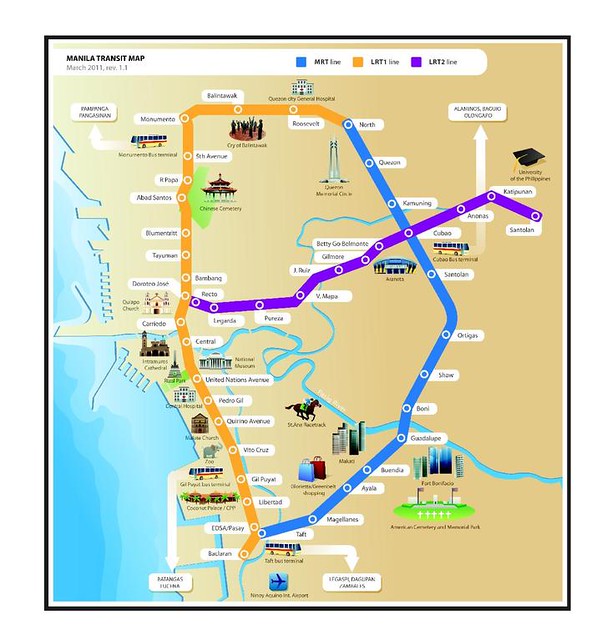
First things first, if you're totally befuddled at Manila's hit-or-miss public transport system, click the photo above to view the Manila Transportation Map - for all it's worth.

Photo from Wikipedia
 To the greenhorn MRT riders, the following tips could be helpful.

1.) Be an Early Bird

There's no better way to beat the morning crush by pre-empting its most congested time span. Manila's three central business districts in Ortigas, Bonifacio Global City, and Makati are located south of its most dense population concentrations. Hence, the rush hour action, if we can call it that, is at the southbound direction.

When riding southbound from the North Avenue station, it's best to board the train before 7:00 AM. After this time, the foot traffic increases significantly. Here's a handy tip: enter the North Avenue station at the Trinoma side, instead of the more crowded Southbound gate. MRT management allows passengers who get in at the Trinoma side to pass underneath a series of stairwells right up to the soutbound side.

More importantly, train breakdowns are common occurences. Bear in mind that the MRT-3 has been running over its designed capacity all these years. Not even the most stringent of maintenance routines can prevent the eventuality of overloaded trains conking out!

2.) Purchase a Stored Value Ticket

If you're boarding the train at rush hour, queing to buy a single-journey ticket could eat up half of your travel time. To escape the snaking, slow-moving lines, a Php 100-stored value ticket is the answer. Riding the entire length of the line costs P15. You can use your stored value ticket seven times. Remember that even if your card has only P1 left in value, you get a free ride.

3.) Protect your Valuables

With a sizable chunk of Filipinos living below the poverty line, Manila has its fair share of thieves, scoundrels and scalawags. The crowded confines of the coaches are fertile ground for these pick pockets. It's better to err on the side of caution - and paranoia. Instead of putting your wallet and mobile phone inside your pant pockets, it is best to put those valuables deep inside your bag. If you're wearing a back pack, carry the bag in front of you.
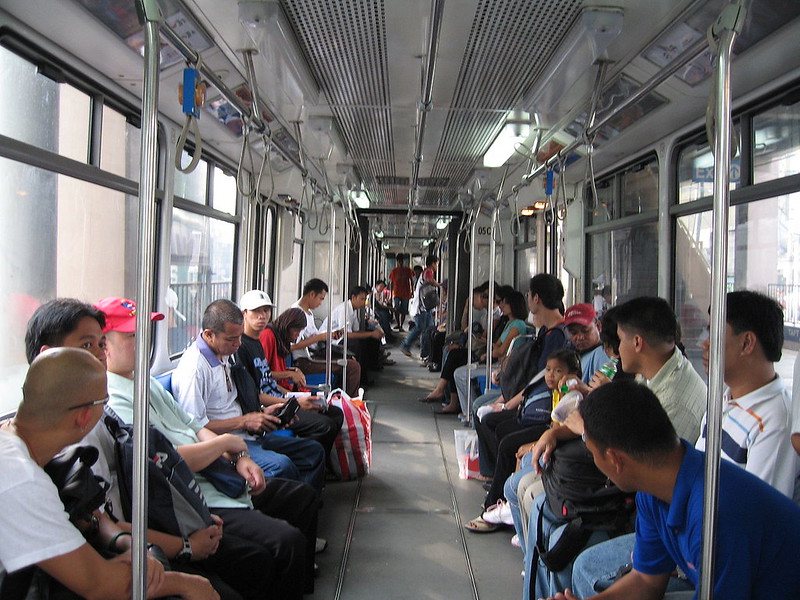
 Coaches aren't always this spacious. (Photo from Wikimedia)

And don't forget to put on your street face. It might just help in making you a less likely target.

4.) Bring an Extra Shirt

The Philippines is a tropical country. For all the advantages a warm climate offers (i.e. you can't freeze to death, you don't wear several layers of clothing), living in a place where noon-time temperatures can reach 36 degrees Celsius in summer can be quite stifling. Since the coaches are almost always crowded, the commuter should be armed with a spare shirt. 

If you're a salaryman/woman, you might want to neatly fold your work clothes inside your bag. Coming to work in slightly creased clothing is way better than being clad in sweat-drenched business attire.

5.)  Park and Ride

The Trinoma mall offers a cost-effect park and ride system for MRT commuters. Riders can park their automobiles at the strategically placed North Avenue carpark building of the mall for a mere P50 flat rate (during weekdays only). Just remember not to go beyond the 2:00 AM cut-off, lest you be charged the overnight parking rate of P150.

Read: "Trinoma Park and Ride"

6.) Box-out

During rush hour, Filipino patrons of the MRT could get quite rude. As soon as the train doors slide open, the disembarking passengers are instantly pushed by an onslaught of warm bodies. In the rat race to get home early and fast (and cheap at that!), proper manners are quickly forgotten.
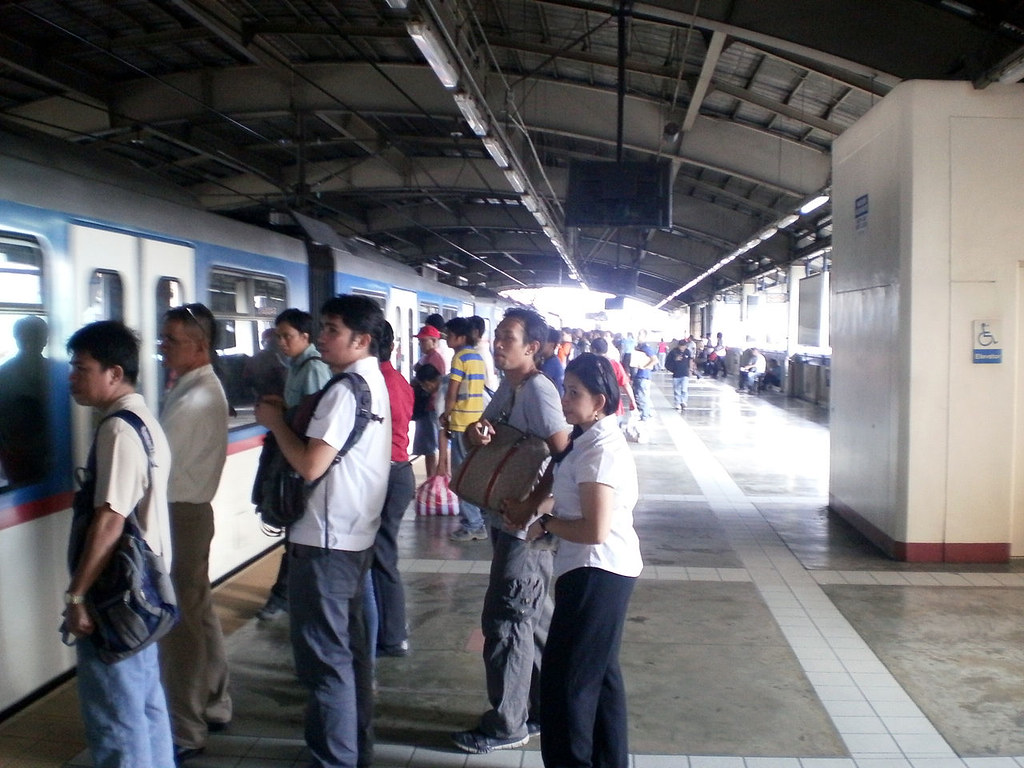
MRT riders aren't always this orderly. (Photo from Wikimedia)

Hence, the alighting passengers (as well as those about to board) should possess decent boxing out technique, especially when disembarking (or boarding) at the most crowded stations (Ayala Station, Shaw Boulevard Station, Quezon Avenue and Cubao). Most Filipino males are no strangers to boxing out. After all, there is a basketball in practically every corner in Metro Manila.

In this day and age of high fuel prices and global warming, taking public transportation is the answer to rid your wallet of gas expense and to do your bit for the environment. The MRT, in spite (or because of) its relatively cheaper fares offer a distinct cost-advantage for the price-conscious Filipino commuter. Despite its inherent ills, one's MRT riding experience need not be stressful.


Tuesday, May 28, 2013

The Flooded Quezon Avenue/EDSA Intersection by Joboy Quintos

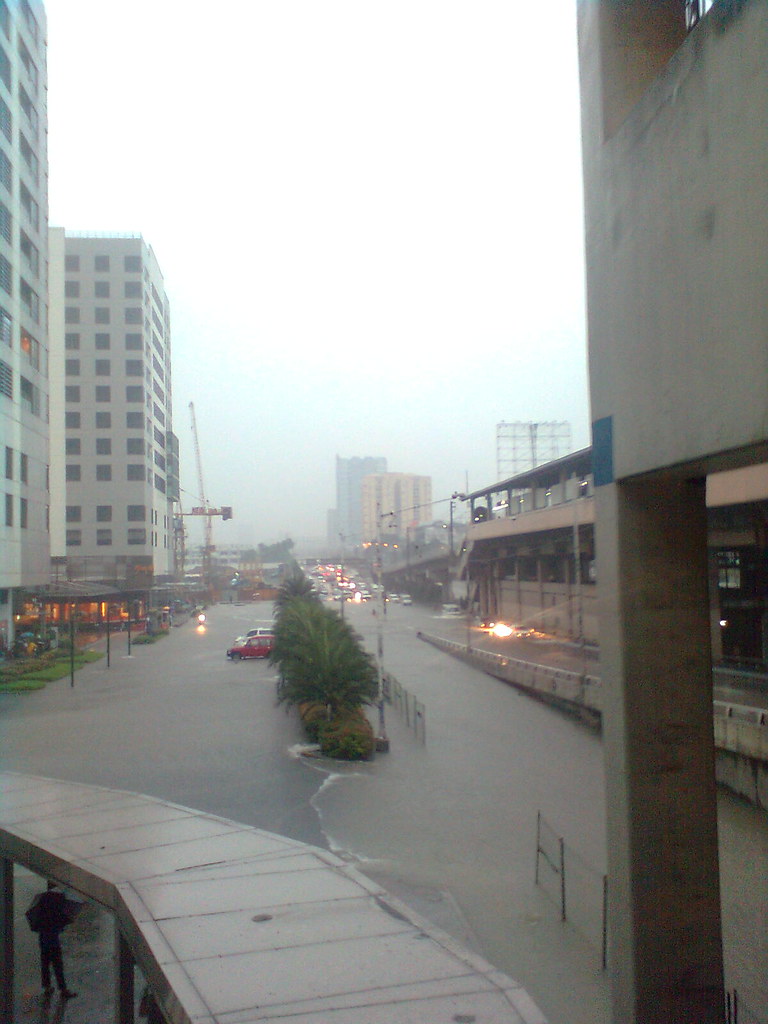
A good part of Metro Manila and the surrounding provinces have been stricken by massive flooding the past few days. The monsoon rains have been unexpectedly strong of late, due to confluence of weather patterns. The crowded metropolis, with its clogged drainage systems and poorly planned urban and suburban centers, drowned in a sea of dirty floodwater. The low-lying areas near the riverbanks were hit particularly hard, reminding many of the fearsome deluge of Ondoy three years ago. 

The social networks and mainstream media beamed images of the floods in real-time. It was heart-wrenching to see our city and our countrymen stricken with so much suffering.

Thankfully, our house is situated in a relatively flood-free part of Quezon City. At worst, I was merely inconvenienced by the flooding. 

The sight of the SM Centris Pond greeted the MRT passengers.
I was supposed to ride a jeepney to Tandang Sora from my usual MRT stop in Quezon Avenue/Centris. However, floodwaters rose to about a meter-high, making the vital artery impassable to vehicles. Save for a few brave and foolish drivers who forded the flooded highway, EDSA became a long parking lot of stranded vehicles. 

 
Marooned. Almost.

Commuters disembarking from the MRT station were more or less trapped, since the SM Centris mall remained shuttered. Some chose to wade through the murky flood waters. Take note that the brilliant minds behind the Eton-Centris facility built over the drainage channels or esteros, which was the most likely cause for the flooding. They could have at least opened the mall doors to their so-called "valued customers."

CLOSED.
I had no other recourse but to turn back and head to the nearby Trinoma station by train. Thankfully, I got home safe, clean, and dry.

Market Situationer (10-14 September 2012) by Joboy Quintos

Government Securities
Yields for last Tuesday’s 10-year Treasury Bond auction stayed within market expectations. The new issue fetched a coupon rate of 4.75%, with the Bureau of Treasury awarding the full P9.0 billion allocation. Total tenders amounted to P44.155 billion, the largest since January 2012. A liquid market and expectations of monetary stimulus abroad fueled the strong demand.

Market players continued to buy securities at the 7- to 10-year tenors, in anticipation of the upcoming bond swap in the fourth quarter of the year. The BTr is set to issue new 5-, 7-, 10-, 15-, 20-, and 25-year tenors in huge amounts (total of at least P300 billion). Doing so would create liquidity in the aforesaid tenors. Since the 7- to 10-year tenors have seen little movement the past months, proprietary traders have realized value in these securities.

The 20-year FXTN 20-17 traded sideways with an upward bias, trading at 5.565% to 5.615% the entire week. The 10-year FXTNs, fell by 8 bps, on average, as 7-year papers dipped by 7 bps. There were hardly any surprises in terms of policy moves last week, as the Monetary Board kept benchmark rates unchanged and revised the 2012 and 2013 inflation forecasts higher – but still within the 3-5% target.

In light of the renewed market interest in the aforesaid tenors, the yield curve was flatter when comparing 2- and 10-year debt (224 bps from 232 bps) and 5- and 10-year securities (0.364 bps from 0.495 bps). Total weekly volume for the secondary GS market amounted to P122.16 billion.

Foreign Exchange
Monetary easing in Europe and in the United States bolstered emerging market currencies and assets. The prospect of lower interest rates in the developed world makes higher-yielding emerging market a more attractive destination for capital flows. Hence, the Peso reached consecutive 4-year highs last week against the U.S. Dollar. The local currency capped the week at P41.42 (+ 0.33) versus the greenback, gaining a total of P0.26 in five days of trading. Total weekly volume for the USD-PHP spot market amounted to $4,506.05 million.

Stock Market
Likewise, the local equities market benefited from the developments abroad. The PSEi surged by a total of 121.15 points last week, closing at 5,322.47 (+ 81.97) on Friday. Total weekly volume amounted to P27.33 billion.

Sources: Business World, PDEX, Philippine Daily Inquirer, Bloomberg

Monday, May 27, 2013

Market Situationer (3-7 September 2012) by Joboy Quintos


Government Securities
The Bureau of Treasury chose to grant a full award of last week’s Treasury Bill auction, despite higher yields in the 182- and 364-day tenors. The 91-day T-Bills fetched an average of 1.249% (- 20.3 bps), as 182- and 364-day papers yielded 1.713% (+ 4.2 bps) and 2.22% (+ 27 bps), respectively. Total tenders soared to a total of P18.72 billion. 

Expectations of monetary policy easing in the United States and in the European Union overshadowed local inflation concerns. Higher-than-expected 3.8% inflation for the month of August failed to dampen the market’s mood, as secondary market yields continued to fall despite some knee-jerk selling. The ECB’s announcement of an “unlimited bond-buying” regime for tenors up to 3 years on Thursday did much to prop up the confidence of the market. 

Throughout last week, yields fell by an average of 8-15 bps, with market players favoring 5-, 10- and 20-year securities. There was renewed interest on FXTNs at the belly of the yield curve, in light of the higher inflation expectations in the near-term. FXTN 20-17 fell from 5.62% at the start of the week to 5.525% by Friday morning. The 5- and 10-year FXTNs, meanwhile, shed 15 bps and 11 bps, respectively.

The yield curve became flatter as a result of the decline in yields. The difference between 2- and 20-year debt fell to 311 bps last Friday from 318 bps the week earlier. Total weekly volume reached P171.74 billion.

Foreign Exchange
The Peso gained a total of P0.38 throughout the entire week, amidst expectations of monetary stimulus in the Eurozone and in the United States. From P41.98 (+ 0.08) on Monday, the local currency capped the week at P41.38 (+ 0.19). Total weekly volume for the USD-PHP spot market amounted to $4,119.84 million.

Stock Market
Despite finishing in the red at the early parts of the week due to Moody’s downgrade of the EU credit outlook, the PSEi managed to eke out a modest weekly gain of 5.13 points.  From a weekly low of 5,150.81 (-25.06) on Wednesday, the main index closed the week at 5,201.32 (+ 51.21). Total weekly volume amounted to P21.37 billion.

Rates Forecast
Traders interviewed by Business World saw the coupon rate for this Tuesday’s new 10-year issue to range from 4.75% to 4.875%.  In the secondary market last week, 10-year papers were trading at 4.715%.  Near-term inflation pressures brought about by domestic and foreign factors could result into marginally higher yields in the auction.

Despite prospects of bond buying in Europe and in the U.S, another rate by the Monetary Board seem less likely in light of the aforesaid inflation uptick brought about by the recent floods.   

Sources: Business World, PDEX, Philippine Daily Inquirer, Bloomberg

Sunday, May 26, 2013

Market Situationer (28-31 August 2012) by Joboy Quintos

Government Securities
There was strong demand for last week’s 7-year Treasury Bond auction, with total tenders amounting to P24.96 billion for the fully awarded P9.0 billion offer. The new issue fetched a coupon rate of 4.75%, slightly higher than the prevailing PDST-R1 rate of 4.725% the morning prior to the auction. 
Secondary market rates fell by around 4-5 bps last week amidst Governor Tetangco’s statement saying that the flood-driven price pressures are just temporary. Robust 2Q 2012 domestic growth and speculation of QE3 in the U.S. could have also bolstered demand for Peso-denominated assets. FXTN 20-17 fell from 5.66% on Tuesday to a low of 5.6395% on Friday afternoon. 

The slight decrease in long-term GS yields resulted into a marginally flatter yield curve week-on-week, as the difference between 2- and 20-year debt declined to 319 bps from 321 bps. Total weekly volume amounted to P66.608 billion, more than double the previous week’s turnover of P32.306 billion.

Foreign Exchange
Global growth concerns, Dollar demand, and a gradually increasing trade deficit saw the Peso depreciate by P0.18 against the U.S. Dollar in the first two days of trading. The local currency closed at P42.345 (- 0.05) on Tuesday. Despite renewed European debt concerns, strong domestic 2Q 2012 GDP growth enabled the Peso to bounce back in the subsequent days, capping the week at P42.060 (+ 0.17). Total weekly volume for the USD-PHP spot market amounted to $3,183.58 million. 

Stock Market

Local stocks gained throughout most of last week amidst bargain-hunting, robust local economic data, and some month-end window dressing. Despite a 46.41 point drop in the PSEi on Thursday brought about by global growth worries, the main index capped the week at 5,196.19 (+ 46.88), gaining a total of 52.84 points throughout the four-day trading week. Total weekly volume amounted to P20.639 billion.

Rates Forecast

Traders interviewed by Business World saw average rates for this Monday’s Treasury Bill auction falling by 5-10 bps, on “ample liquidity in the system and bullishness among investors” on robust economic data. The 91-, 182-, and 364-day T-Bills last fetched average yields of 1.452% ( - 4.3 bps), 1.671% (- 12.4 bps), and 2.125% (- 22.5 bps), respectively.

Inflation data will be released this Thursday, so expect CPI expectations to dictate the tempo of trading. A Business World poll yielded a median estimate of 3.55%, within the higher end of the 2.8-3.8% BSP outlook this month – higher than July 2012’s 3.2%. 

Sources: Business World, PDEX, Philippine Daily Inquirer, Bloomberg

Saturday, May 25, 2013

Market Situationer (22-24 August 2012) by Joboy Quintos

Government Securities
Treasury  Bill  rates  again  fell  during  last  Wednesday’s  auction,  amidst  demand  for  short-term  government  securities. Average yields for 91-, 182-, and 364-day T-Bills fetched 1.452% (- 4.3 bps), 1.671% (- 12.4 bps), and 2.125% (- 22.5 bps), respectively. The auction was fully awarded at P7.0 billion. Total tenders amounted to P13.371 billion. 

The 235%  month-on-month  increase  in  the  budget  deficit  (from  P11.70  billion  in  June  to  P39.25  billion  in  July)  compounded expectations of flood-induced inflation pressures. As a result, secondary GS market rates traded sideways with an upward bias. Most of the limited market activity was again focused on the longer tenors, particularly in the 20-year securities. FXTN 20-17 traded between 5.66% and 5.68%, while RTB 20-1 ranged from 5.71%  - 5.7175%  - hardly changed from the closing yields of 17 August. 

Foreign Exchange

The Federal Open Market Committee’s (FOMC) comments that additional monetary stimulus might be needed should the U.S. economy continue to exhibit signs of weakness, bolstered the Philippine Peso. Another round of debt purchases in the US “would entail the printing of dollars that would weaken the U.S currency,” according to the minutes of the FOMC meeting reported in Business World. As a result, the Peso gained P0.31 against the Dollar in the first two days of the abbreviated work week, closing at P42.110 (+ 0.18) on Thursday. Concerns about the measures taken to deal with the European debt crisis and concerns about slowdown in the U.S. and Chinese economies boded ill for the local currency, as it capped the week at P42.165 (-0.055). Total weekly volume amounted to $2,793.61 million.    

Stock Market
The PSEi retreated by 54.66 points to close at 5,152.15 on Wednesday, as local stock prices were negatively affected by worse-than-expected Japanese exports data, according to analysts interviewed by Business World.  The main index rebounded by 50.69 points  (5,202.84) the next day, amidst talk of QE3, but fell by another 59.49 points on Friday on global growth concerns. The PSEi closed the week at 5,143.35 (-59.49). Total weekly volume amounted to P12.15 billion.

Rates Forecast
Expect the coupon rate for next week new, 7-year Treasury Bond issuance (FXTN 7-55) to range from 4.75 – 4.875%. Bids higher than 4.875% might merit a rejection from the Bureau of Treasury. The closest 7-year security in the secondary market last fetched 4.72% on 17 August, with the PDST-F and PDST-R2 yields on 24 Aug at 4.9296% and 4.725%, respectively.

Although there is a sizable RTB maturity on the 24th of September (Php 30 billion), secondary market trading next week will be primarily dictated by the results of the 7-year auction and market expectations of August inflation data (to be released on 5 September). Rates in the secondary market could trade sideways with an upward bias next week.

Sources: Business World, PDEX, Philippine Daily Inquirer, Bloomberg

Friday, May 24, 2013

Market Situationer (13-17 August 2012) by Joboy Quintos

Government Securities
Last week’s 91- and 182- day T-Bill average yields fell amidst strong demand in the auction, as investors looked for “short-term investments where they can temporarily park their funds,” according to the National Treasurer. Average yields for the 91- and 182-day bills fetched 1.495% (- 30.5 bps) and 1.795% (- 32.2 bps), while 364-day bills dropped 14.3 bps to 2.422%. Total tenders for the partially awarded auction amounted to P21.30 billion. The BTr capped the awards for 364-day bills at P3.6 billion, as it issued a total of P7.1 billion worth of short-term debt out of the P7.5 billion offer.


With the workweek cut short by the monsoon rains and metro-wide flooding, trading volumes were relatively light the entire week. News of higher inflation in July 2012 and price-driven pressures brought about the massive flooding dampened the market’s mood, resulting into a gradual climb in secondary market rates towards the end of the week. Yields for the 19-year FXTN 20-17 rose to 5.60% from 5.535% at the start of the week. Likewise, the 20-year RTB 20-1 gained 8 bps to cap the week at 5.675%.

Higher long-term GS yields resulted in a steeper yield curve, as the difference between 2- and 20-year debt increased to 309 bps from 300 bps the week earlier. Trading volume for the week fell to P44,716.11 million from P109,787.83 million.

Foreign Exchange
With financial markets closed on Tuesday, market players sold some of their accumulated U.S. Dollar positions, resulting in a P0.065 appreciation for the Peso (P41.77). The local currency capped the week marginally weaker against the Dollar, as slower-than-expected Chinese exports growth stoked risk aversion (P41.885 -0.125). Total weekly volume for the USD-PHP spot market amounted to $2,945.66 million.

Stock Market
The PSEi surrendered 52.06 points (5,256.61) on Thursday, on “sluggish trading” and the perceived negative effects of the monsoon-induced flooding. The main index closed the week at 5,263.35 (+ 6.74). Total weekly volume amounted to P20.59 billion.

Rates Forecast
The coupon rate for next Tuesday’s 25-year Treasury Bond could range from 5.75% - 5.875%, as yields react to renewed inflation concerns. Last Friday’s 25-year PDST-R2 stood at 5.80%. Demand for the long dated paper is expected to be large, since most of the market appetite is centered on the longer end of the curve.

Expect the secondary market to trade sideways with an upward bias, should inflation worries over the near-term prevail.

Sources: Business World, PDEX, Philippine Daily Inquirer, Bloomberg

Tuesday, October 2, 2012

JUNK THE CYBERCRIME ACT

In a country that supposedly takes pride in its bloodless People Power Revolt of 1986, a draconian law has been passed curbing freedom of expression.

JUNK THE CYBERCRIME ACT

Tuesday, September 18, 2012

Marlene Dietrich - Illusions

Friday, August 17, 2012

Market Situationer (13-17 August 2012) by Joboy Quintos

Government Securities
The newly issued 25-year FXTN fetched a coupon rate of 5.75% last Tuesday, which fell at the lower end of the market projections. Total tenders for the fully awarded P9.0 billion offer amounted to P26.26 billion.

Secondary market rates, particularly the longer dated securities, rose at the early parts of the week due to higher inflation expectations brought about by the recent flooding. FXTN 20-17 and RTB 20-1 peaked at 5.67% and 5.75%, respectively. The 20-year GS rose by an average of 10 bps from the closing rates on 10 August. The auction results and BSP statements that 2012 inflation would fall well within the 3-5% target somehow eased the selling pressure. As a result, rates for FXTN 20-17 dipped to 5.5925%, while RTB 20-1 fell to 5.65%.

Towards the end of the week, however, trading volumes thinned as the market approached the so-called “ghost month.” In addition, better than expected U.S. retail sales and housing permits resulted in a sharp increase in longer-dated U.S. Treasuries. Hence, demand for riskier assets like Peso-denominated securities declined, as shown by the P0.405 depreciation of the local currency against the U.S. Dollar. FXTN 20-17 closed the week at 5.685%, while RTB 20-1 ended the week at 5.72%.

The difference between 2- and 20-year debt rose to 318 bps from 309 bps the previous week. Higher rates in the longer end of the curve resulted into a steeper yield curve. Total weekly volume amounted to P74.16 billion, up from P31.706 billion.

Foreign Exchange
The U.S. Dollar strengthened against the Peso the entire week as the U.S. economy exhibited signs of recovery (higher-than-expected retail sales and housing permits). A stronger U.S. economy makes the prospect of another round of quantitative easing less likely. From P41.930 (-0.045) on Monday, the Peso capped the week at P42.42, depreciating by a total of P0.535 against the Dollar. Total weekly volume for the USD-PHP spot market amounted to $4,456.65 million.

Stock Market
The PSEi traded sideways with an upward bias in the first three days of trading, amidst an absence of major leads. The main index closed at 5,266.66 (+0.72) on Wednesday, before surrendering -47.15 points the next day (5,219.51) as market players cashed in profits ahead of the four-day weekend. The PSEi capped the week at 5,206.81. Total weekly volume of trades amounted to P21.06 billion.

Rates Forecast
Market players could again flock to the safety of shorter term Treasury Bills. However, foreign funds might shun Peso-denominated securities amidst the relatively higher U.S. Treasury rates and the recovery signs shown by the U.S. economy. Average yields for the Treasury Bill auction on Wednesday could move sideways with an upward bias, as a result. The 91-, 182-, and 364-day T-Bills last fetched average yields of 1.495% (- 30 bps), 1.795% (+ 32.2 bps), and 2.422% (+ 14.3 bps), respectively.

The bearish sentiment in local GS market might persist in the near-term.

Sources: Business World, PDEX, Philippine Daily Inquirer, Bloomberg

Wednesday, August 15, 2012

(Virtual) Reality: Growing up in the age of TV, Internet and Facebook

A couple of nights ago, we had dinner we some of my dad's first cousins. They were from another, shall I say, less technologically-endowed generation. They were quite appalled at the seeming disjointness of today's youths from the real world. The advent of the internet - of Web 2.0, social networking and Facebook - is the main culprit. They rued the fact that kids nowadays hardly play outdoors anymore, choosing to live quasi-anonymous online lives instead. Kids today tend to border on the sedentary, as they neglect physical activities in favor of the computer chair or the couch.

Frankly speaking, I can relate to both sides of the spectrum. My generation is old enough to remember the pre-Internet days - when kids actually go outside the house to play games. But then again, I'm young enough that instant messaging and social network comes quite naturally.

As kids growing up in the late 80's up to the mid-90's, my dad controlled our access to the ever tempting world of television, computer games and information technology. We weren't allowed to watch the boob tube during school days. On weekends, our TV viewing time was limited from 12 nn to late evening. My dad gave my brother and I obsolete computers to discourage us from playing the most popular computer games. Moreover, he staunchly refused to provide gaming consoles like the iconic Nintendo and Play Station.

Instead, my parents made available a wondrous endowment of books, music lessons and enrolled us into every imaginable summer sports clinic.

Of course, I resented those restrictions. I couldn't appreciate the limited TV time and uber-slow 2x86 computers. I had no other choice but pore over the multitude of books. In literature, I discovered a wealth of wonders. I developed a wild imagination where I used to daydream for hours at length. I wasn't overly enthusiastic with the repetitive piano lessons, but it did succeed in instilling musical appreciation. I did not appreciate the early swimming, tennis and basketball lessons at first, but in time, I developed an intrinsic love for track & field that persists until this very moment.

As we grew older, the restrictions loosened and eventually disappeared. By the time I was in college, I was pretty much free to do everything I want, in light of my new-found maturity. I still did not watch TV during weekdays, in light of the grueling demands of academics and athletics. But I did develop an above average proficiency for literature. I could express my thoughts eloquently in writing and in speech.

In time, I became thankful for my parents' unique style of upbringing.

In this day and age of convergence, broadband internet and Facebook, I am confident that I won't get lost in the proverbial technological jungle. There's always this danger of blurring of the lines between reality and virtual reality.

Now that I'm approaching quarter-life, I can say in honesty that I'm living a well-balanced life. Just like most of my peers, I'm pretty much connected through the use of Facebook, Twitter and Wordpress. I could spend hours tinkering with the aforesaid sites. More importantly, I remain well-connected with reality, having a vibrant social life and a multitude of athletic pursuits.

I absolutely love the ease of communication brought about by Twitter and Facebook. I maintain a detailed blog, sharing it to a multitude of people from all over the globe, thanks to the World Wide Web. But I make it a point not to live a life disjointed from what's real.

Real world interactions form the foundations of my online alter-ago.

Saturday, July 28, 2012

Awkward Ads

My mom works in the life insurance industry.  I've been exposed to the rudiments of the industry at such a young age. There's a rivalry between the Philippines' two largest insurance firms, Sunlife Financial and Philam Life (my mom works for the former).


For the past weeks, I've seen Nuffnang show Philam''s Bamboo Manalac ads on my Superb Senora blog. I would have preferred Sunlife since I'm a Sunlife kid, but then again I don't have a choice. Lo and behold, I was stunned to see Philam ads juxtaposed with the Sunlife ad campaign featuring Piolo Pascual!


Awkward, much?

Friday, July 27, 2012

Market Situationer (23-27 July 2012)

Government Securities
Expectations of a cut in benchmark interest rates drove down bids for last week’s Treasury Bill auction. The 91-, 182-, and 364-day bills fetched average yields of 1.80% (- 20.8 bps), 2.117% (- 5.5 bps), and 2.279% (- 20.9 bps), respectively. Total tenders for the fully awarded P7.5 billion offer amounted to P20.69 billion, the largest volume of bids this year.

Secondary market yields fell all throughout the week, as market players priced in a cut in the policy rates and negligible budget deficit. FXTN 20-17 dropped 7.5 bps to hit a low of 5.485% on Wednesday, as RTB 20-1 bottomed at 5.5357% from 5.625% at the start of the week. Likewise, the 10-year FXTN 10-54 retreated by 8.5 bps to close the week at 4.85%. The market’s expectations were confirmed on Thursday, as the Monetary Board cut benchmark rates by 25 bps and the June 2012 budget deficit remained manageable at P11.96 billion.

The rate cut resulted in a slightly higher shorter end, resulting into a relatively steeper yield curve compared to a week before. The difference between 2- and 20-year debt on 27 July amounted to 293 bps, marginally higher than the 290 bps on 20 July. Total weekly volume for the secondary GS market amounted to P175 billion.

Foreign Exchange
The Peso traded on the weaker side against the U.S. Dollar throughout most of the week, as expectations of a rate cut made Peso-denominated assets less attractive for foreign funds. The local currency lost a total of P0.325 in the first three days of trading, closing at P42.185 (-0.14) on Wednesday. A statement by the ECB pledging strong support for the Euro buoyed market sentiment towards the end of the week, despite the 25 bps cut in benchmark policy rates. As a result, the Peso closed at P41.90 (+0.195) on Friday. Total weekly volume for the USD/PHP spot market amounted to $4,534.64 million.

Stock Market
Talk that Spain might require a bailout soured the market’s mood on Monday, resulting in a 71.49 point drop in the PSEi. The main index closed at 5,139.40 on Monday, before rebounding 22.30 points in the next two days as local stock prices were buoyed by rate cut expectations. The PSEi gained 66.99 points on Friday on the encouraging ECB statement, capping the week higher at 5,219.55. Total weekly volume amounted to P26.24 billion.

Rates Forecast
The BTr will issue a new tranche of 10-year bonds on Tuesday. In light of tame inflation expectations and negligible budget data, as well as the upcoming P33 billion in Treasury Bond maturities, rates for the auction could head south. Expect the coupon rate to range from 4.625% to 4.75%, lower than the 4.85% in the secondary market.

Sources: Business World, PDEX, Philippine Daily Inquirer, Bloomberg

Friday, July 20, 2012

Market Situationer (16-20 July 2012)

Government Securities
Yields for last Tuesday’s 7-year Treasury Bond auction fetched a coupon rate of 4.75%, within market expectations. Total tenders amounted to P20.951 billion for the fully awarded P9.0 billion offer.

Secondary GS yields fell throughout most of last week, amidst the absence of any upward pressures in domestic interest rates. Buying interest was stoked by expectations of negligible fiscal deficit, next week’s Monetary Board meeting, and to some extent, hopes of further monetary easing by the U.S. Fed. Yields for FXTN 20-17 dove to 5.555% on Friday afternoon, down 7 bps from Monday’s levels. Likewise, FXTN 25-8 bottomed at 5.725% from 5.80% on Monday. The 10-year FTXN’s also saw relatively higher volumes, as rates for these papers fell below 5.0% for the first time in four months.

The difference between 2- and 20-year debt declined to 290 bps from 298 bps a week earlier, as the longer end of the curve shifted downwards. This is the flattest the yield curve had been since March 2012. Total weekly volume amounted to P172 billion.

Foreign Exchange

Stimulus hopes from China and the U.S. fanned risk appetite. The Peso appreciated by P0.30 against the U.S. Dollar in the first three days of trading. The local currency closed at P41.68 (+0.045) on Wednesday, matching its highest level against the Dollar this year. It closed the week at P41.860 ( -0.105). Total weekly volume for the USD-PHP spot market amounted to $4,401.18 million.

Stock Market

After gaining 83.47 points on Monday (5,297.99) on stimulus news, the PSEi shed 108.62 points in the next three days, amidst lower economic growth forecasts by the IMF and disappointing retail sales data in the U.S. The main index rebounded by 21.52 points on Friday, to cap the week at 5,210.89. Total weekly volume amounted to P31.72 billion. 
 
Rates Forecast
Expect yields for this Monday’s Treasury Bill auction to fall by 5 to 10 bps, as it aligns with the lower secondary market yields. The 91-, 182-, and 364-day bills last fetched 2.008%, 2.172% and 2.488%, respectively, in the secondary market.

The Monetary Board will meet on Thursday, coinciding with the release of the budget data. Downward momentum might continue prior to the 26th of July, especially if foreign news turn out to be conducive for speculative flows into the local markets.

Sources: Business World, PDEX, Philippine Daily Inquirer, Bloomberg

Saturday, July 14, 2012

"Blue Eagle, The King"

I can still remember my first ever Big Blue Eagle Cheer Rally back in 1999. I was a high school freshman, a product of a small, tight-knit learning institution in Don Antonio Heights. Unlike most of my classmates who came from the Ateneo Grade School, I stood out like a sore thumb. I had a hard time taking in all the foreign notions of Ateneo Spirit. The cheers, in particular, were unintelligible jibberish I found difficult to appreciate.

Soon enough, the school spirit rubbed off on me, probably because of all the hurdling and sprinting I did donning the old Blue and White. Or maybe I was just brainwashed. Save for the Alma Mater song, I still found the cheers and most of the school songs pretty much alien. 

In light of my ignorance of the other school songs, I wondered where those "Ateneo Will Fight Today" tarps came from. A quick Google search answered my query. In the midst of last year's UAAP cage wars, I also found the lines "Fly high, Blue Eagle Fly and carry our cry across the sky" perfect for Facebook status messages and tweets. I developed a certain fondness for "Blue Eagle The King."

The song traces its origins from the pre-World War II Ateneo and the late Raul Manglapus. Back in those days, local schools usually borrowed the cheers and songs from its colonial counterparts in America, according to the University Archives website. "Blue Eagle The King" was unique since it was completely home grown. 

I scoured the web for copies of the song. I found a Youtube clip of Eddie Mercado and the Executives Band performing the song:


Blue Eagle The King
by Raul Manglapus (1939)

Fly high!
Blue Eagle fly
And carry our cry
Across the sky!
Cast your shadow below
Swoop down on the foe,
Then sweep up the field away!

Fly high!
Over the trees
Make known to the breeze
Our victories!
Spread wide each wing
For you are the King
Blue Eagle the King!

Oh the Eagle's the King of them all
And his blue feathers never will fall
For the Blue and the White
And the Eagle in Flight
Ateneo will fight today!

Fly high!
Over the trees
Make known to the breeze
Our victories!
Spread wide each wing
For you are the King
Blue Eagle the King!

Source:
Ateneo de Manila University Archives

That Gotye Song

Friggin' hilarious!


For more of the BreakfastToms, visit their Youtube Channel.

Friday, July 13, 2012

Market Situationer (9-13 July 2012)

Government Securities
The Bureau of Treasury made a partial award of last Monday’s Treasury Bill auction. Average yields for the 91-, 182- and 364-day bills were at 2.008% (- 16.6 bps), 2.172% (- 10.2 bps), and 2.488% (+ 3.8 bps), respectively. The rates fell amidst benign inflation data and S&P’s credit upgrade the previous week. The BTr put a cap on the bids for the year papers, as it accepted only P3.2 billion out of the P4.0 billion offer. Total tenders amounted to P13.755 billion.

Read: "Track Beauty of the Week - Murielle Ahouré"

Secondary market rates inched upward during the early parts of last week. Yields again dove in the last two days of trading, as news of BIR’s larger June 2012 collections and the BSP’s slashing of the SDA rates by 3.25 bps drove up demand for long-term government securities. FXTN 20-17 fell from a weekly high of 5.7725% to 5.6575% on Friday. RTB 20-1, meanwhile, dropped from 5.86% to 5.75%.

Market Situationer (2-6 July 2012)

Government Securities
The Bureau of Treasury awarded last Tuesday’s Treasury Bond auction in full. The newly issued 5-year paper fetched a coupon rate of 4.625%, a bit lower than the prevailing secondary market rate for outstanding securities of the same tenor. Total tenders for the fully awarded P9.0 billion offer amounted to P28.049 billion.


Secondary market yields dropped dramatically last week, as (1) S&P upgraded the Philippines’ sovereign debt rating to BB+, (2) expectations of tame June 2012 inflation, (3) signals of monetary easing by Chinese and European policy makers. GS market rates fell to its lowest levels in four months, as both domestic and foreign financial institutions went on a buying spree. Yields for FXTN 20-17 hit a low of 5.59% on Thursday morning, down from a high of 5.8695% on Monday. Likewise, the 25-year FXTN 25-8 shed 35 bps to trade at 5.70% as 10-year papers fell by an average of 10 bps. 

Friday, July 6, 2012

Supporting the Kick-It Foundation

I've been watching quite a lot of tennis the past few weeks. Since it's Wimbledon season, the internet is abuzz with news from the Championships. While browsing through the news feed of my Facebook account, I came across photos of Serena Williams, Ana Ivanovic Ана Ивановић, and Victoria Azarenka (Вікторыя Азаранка Виктория  Азаренко) pledging their support for the Kick-It Foundation.

Click this link to read the full article...

Thursday, July 5, 2012

Muse – Survival (Official Song of the 2012 London Olympic Games)

I got goosebumps watching this. Let the Games begin!!!